One Month Back
One Month Back
What disrobing taught me about belonging, and what I’m building next.
I’m writing this a few days after the actual one-month mark. I sat down on the day itself and just felt scatterbrained. That lag feels like it belongs in the post rather than smoothing it out: write it while it’s still happening, not after it’s had time to harden into something neater than it was.
The scorecard I’m trying not to make
For years I looked at my life through a set of buckets — mental, physical, relational, spiritual, work, and half a dozen more like it. They overlap constantly, but the framework was useful: almost any suffering I was sitting with could be traced back to a neglected bucket. In the past I tracked all of this rigorously, numeric scores across every category. It worked, in the sense that it produced data, but it lacked compassion. It was a system for grading myself, not for understanding myself.
The thing I keep coming back to instead, from my last few weeks as a novice, is the Sutra on the Full Awareness of Breathing. Not a scorecard. Just: notice the breath, notice the body, notice what’s arising, without the extra step of assigning it a number. One month back into lay life, that’s the lens I want to use here instead of a report card.
Returning home to the breath
A friend who recently ordained into the Order of Interbeing asked me a good question: what’s been hardest and easiest about returning to lay life in NYC? The easiest has been coming home to myself by returning to my breath. Two years at the monastery built that habit deep enough that it’s held. It’s been my default response to nearly everything this month, the small annoyances and the large ones alike.
It got tested plenty. NYC has its stressors: crowds, my grandparents’ old block in the East Village — where I grew up — unrecognizable under gentrification, the specific flavor of anger that shows up when an MTA bus fare inspector starts feeling less like transit enforcement and more like something uglier. I’m not interested in performing equanimity I didn’t feel. I felt the anger. What’s different from before the monastery is that I could name it and breathe with it in real time instead of either suppressing it or being run by it. That’s the practice actually working, not the practice being absent.
Why I gravitated toward Thầy in the first place
Part of what drew me to Thich Nhat Hanh’s teaching is that he’s practical about mindfulness and Buddhist practice. It’s easy to read him as fluffy zen metaphor, and sometimes it is exactly that, but when he stays grounded in the material reality of the body and of suffering, it lands for me. I have very little interest in the mystical, superstitious, or purely historical layers of Buddhism. I’m interested in what’s practically true about suffering, about how people relate to each other and themselves, the parts that don’t expire.
That distinction matters for what comes next, because it’s the frame I want to hold the hardest part of this post in.
The thing that actually deepened this month
I disrobed last month. That’s the news underneath everything else in this post, and I want to say it plainly instead of letting the next few paragraphs sneak up on it. Two years at Blue Cliff gave me more than I can fit in a post. A body that knows how to breathe, brothers I love, a practice that held me through things I couldn’t have carried alone. What follows isn’t a verdict on any of that. It’s the one fracture I couldn’t mend from the inside.
One of the main reasons why I disrobed was because of the lack of diversity and inclusion in the sangha. After several challenging and disheartening situations with racism, in both the monastic and lay communities, I felt that I could do more to relieve suffering, build community, practice and share the Dharma among a more diverse and inclusive environment. I wrote over ten drafts of my disrobing letter, carefully and skillfully crafting these challenges as Dharma doors to embody the Buddha and Thầy’s teachings, not as critiques or judgment of any single person or the sangha.
Without naming them, one of the eldest monastics at Blue Cliff censored me through veiled threats of not being welcomed back as a lay practioner if I didn’t remove these topics from the letter. They went as far as saying, “Social issues will always exist and you can’t do anything about it.”
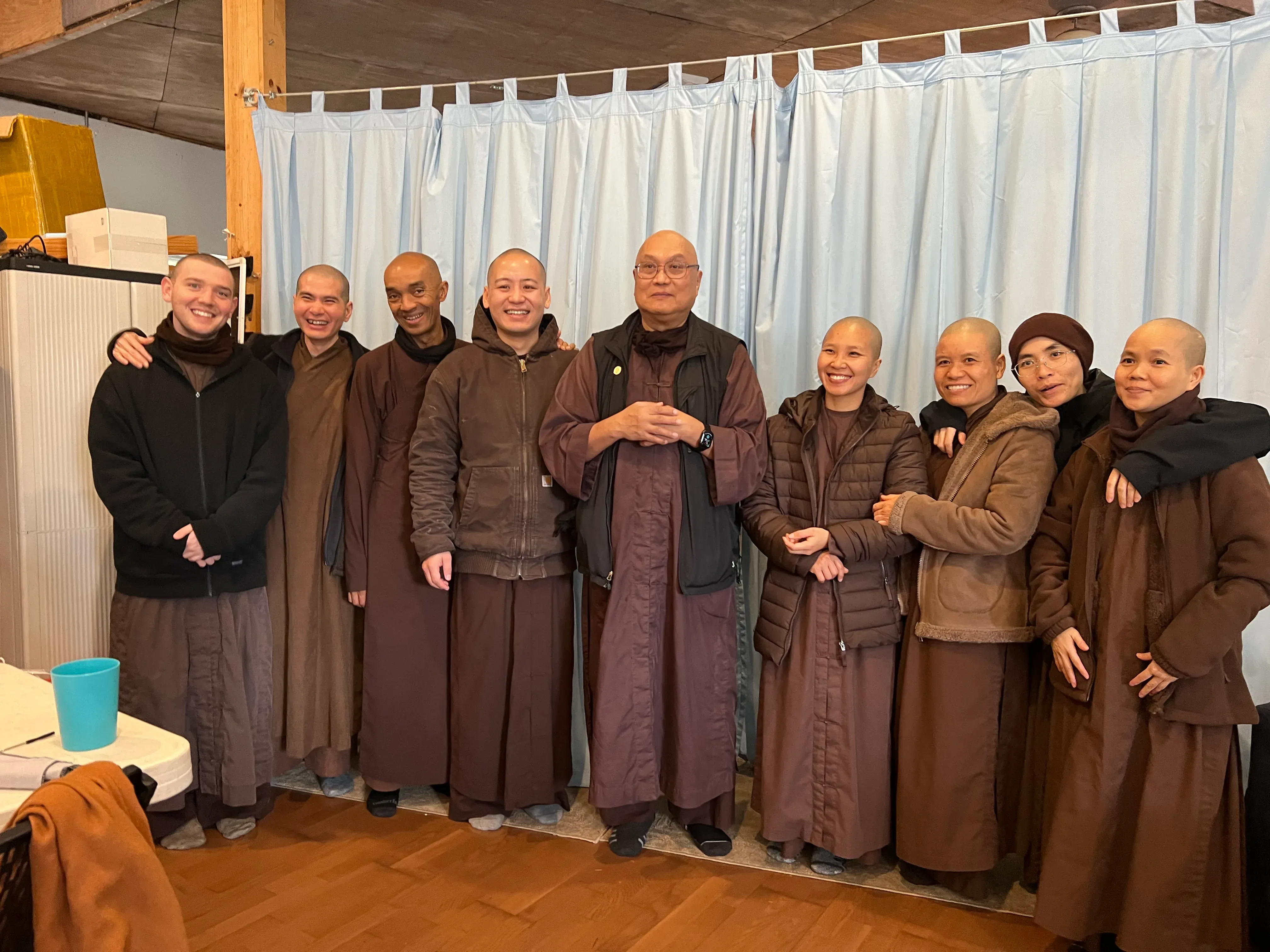
Processing the immediate wave of anger took a few days, and honestly continues now. As a child of poor working class Chinese immigrants, I’m no stranger to complicated Asian family cultural dynamics of power, filial piety, and saving face. As I contemplated, and eventually drafted their requested censored version, I also spent time with individual brothers to say my farewells and express my gratitude. Each of these brothers showed me love, understanding, and presence and that made it clear that this particular monastic’s opinion is just that, their opinion. They don’t represent the sangha as a whole.
I realized that this particular monastic simply has not had the conditions to ever fully understand what I needed them to say. The Buddha himself said not to be dogmatic about anything, including his teachings. I can’t hold anyone up to my definition of Engaged Buddhism. That has to extend to how I hold the people who disappointed me, too. The point isn’t that this one monastic failed some test. It’s that monastics are just people, carrying whatever conditions they arose in, same as the rest of us. And once I saw it that way, the decision was already made: I wasn’t going to change the monastics I had philosophical friction with, and I wasn’t going to change myself inside that structure without giving up what I went into monasticism wanting in the first place. Making peace with that was one half of this month. The other half was finding out what I was leaving toward.
The other side of it: I reconnected over tea with a CTC member of the Brooklyn BIPOC Sangha. Her presence alone had been a refuge when their sangha visited Blue Cliff, and our conversation was one of the most nourishing moments of the month. She pointed me toward sanghas and people actually organizing around the values I’d been looking for: diversity, inclusion, social justice, practiced rather than gestured at. I’m looking at becoming an active participant there. That conversation is what confirmed disrobing was the right call.
What belonging led me to build
Belonging, for me, was never going to be passive. But I’d learned my lesson at Blue Cliff: the work isn’t changing the people or the place around me. It’s growing what I can bring, and giving it. The primary thing is still the practice itself: carrying trauma as a person of color and healing in relationship with others, not alone. The secondary thing is what I’m good at, marketing, software engineering, building things, pointed at that same community.
This month that took concrete shape. I’ve spent a chunk of my energy refreshing my software engineering skills through a few experiments and the one I keep returning to is a sangha management tool. It came out of a pattern I kept hearing: sanghas holding themselves together with Google Groups, email threads, group chats, a dozen different tools, and no single place built for what they actually do. If you organize a sangha and you’ve felt that friction, I’d love to talk — I want to build something shaped by the real, lived experience of running one. Please reach out.
Closing
A month in, the throughline isn’t the breath by itself, and it isn’t the scorecard I started with. I left the monastery to find my people, and to be more useful to them than I could be from inside. The breath is how I stay steady while I do that. But belonging and being useful to the people I belong with is the actual point.